We've been making subtitles since 1982.
Here's what AI got wrong.
Subtitles are more common than they have ever been. AI made that possible. Generation has become cheap and scalable, and transcription accuracy is genuinely impressive. That part of the story is true.
But something else happened at the same time. Many subtitles became harder to watch.
The reason is simple: getting the words right is only the first part.
Transcription and subtitling are two different problems
Transcription turns speech into text. Subtitling turns accurate text into something a viewer can actually read while watching a video. That requires a different set of decisions: how fast the text appears, where lines break, how long each block stays on screen, whether the timing follows the rhythm of the speaker.
AI caption tools were built to solve the first problem. The second was largely left behind. The result is captions that are accurate and uncomfortable to watch at the same time.
What we watched happen
We have been making subtitles since 1982. We have watched every shift in this field: from pencil and paper to desktop software, from manual timing to semi-automated tools, and now to AI generation at scale.
The jump to AI was genuinely impressive. Transcription got dramatically better, fast. We are not nostalgic for slower processes. Getting accurate text automatically is real progress, and it opened subtitling to a far wider range of video and a far wider range of people.
But we also watched what was left behind. The craft layer. The decisions that turn an accurate transcript into subtitles a viewer can actually follow. Reading speed limits, phrase-based line breaks, timing calibrated to spoken rhythm, consistent block shape. These are not refinements you add later. They are what makes the difference between text that viewers follow without thinking about it and text that wears them out.
We decided to do something about it.
A free SRT editor for anyone
We built an SRT editor that measures any subtitle file against the professional standards we have applied in our own work for four decades. Every cue is checked for reading speed, line length, line count, cue duration, minimum gaps between cues, overlapping timecodes, empty cues, and whitespace errors. The file gets an overall quality score from 0 to 100, and each problem shows what it costs.
It runs entirely in your browser. Nothing is uploaded. No account required.
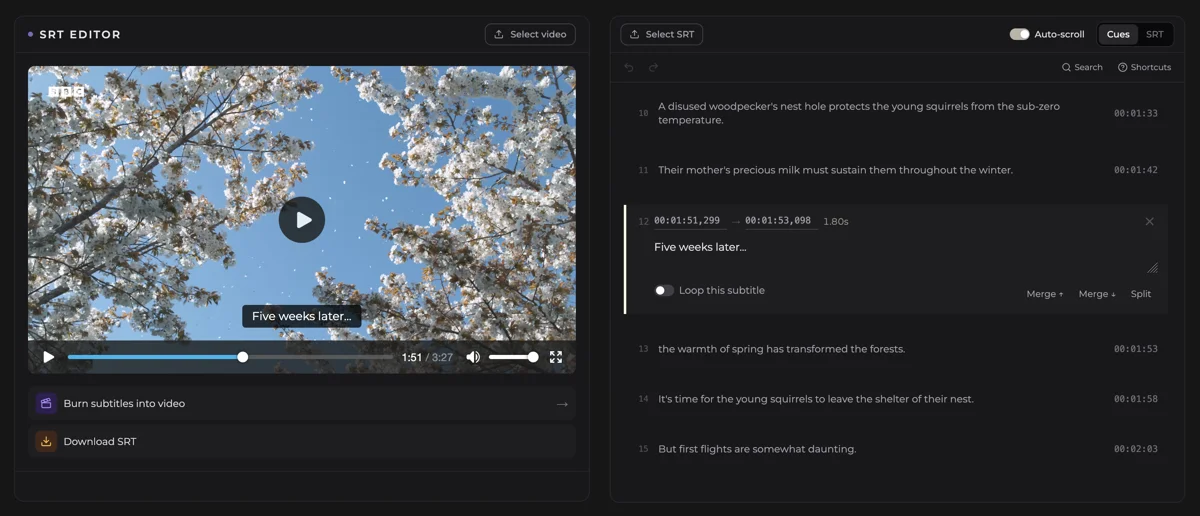
We did not build it to gate the knowledge behind a paywall. We built it because the standards that make subtitles good should not be locked inside professional subtitle studios. Anyone producing video with subtitles should be able to check their work against real standards. Now they can.
Check your own SRT file in the editor and see where your subtitles are easy to read, too fast, or badly segmented.
If you want subtitles that already meet these standards, the AI subtitle generator applies them automatically during generation.