The History of Subtitling
Professional subtitling has a longer history than most people realize. What looks simple on screen has been a demanding craft for decades. Understanding that history explains why readable subtitles require more than just a transcript.
This piece traces subtitling from its earliest days through the prep unit era of the 1980s and into the AI-assisted workflows of today.
The Early Process
In the early days, producing subtitles involved transcribing or translating the original dialogue, sometimes working from a pre- or post-production script.
Film and Television
For celluloid film, a chemical process was used: text was burned directly into the film material itself.
For television, the "camera method" was used instead. The video image was combined with the subtitles during the broadcast. While a programme was being broadcast live, a camera was pointed at a card displaying a subtitle, and the two images were merged to create the subtitled broadcast. A mechanical system ensured the subtitle cards were placed in front of the camera in the correct order.
The person responsible for this was called the title director. They were not the translator, so practice runs were done before each broadcast to ensure the correct subtitle appeared at the right time and for the right duration. This was a challenging task, particularly when seeing the programme for the first time.
The Title Director
What made the title director's job even more challenging was working with films in less common languages. It was known to happen that the title director was left with a handful of unused subtitle cards at the end of a Japanese film.
Since a feature film typically contains around 700 subtitles, one also had to be careful not to drop the stack of subtitle cards while preparing for the broadcast.
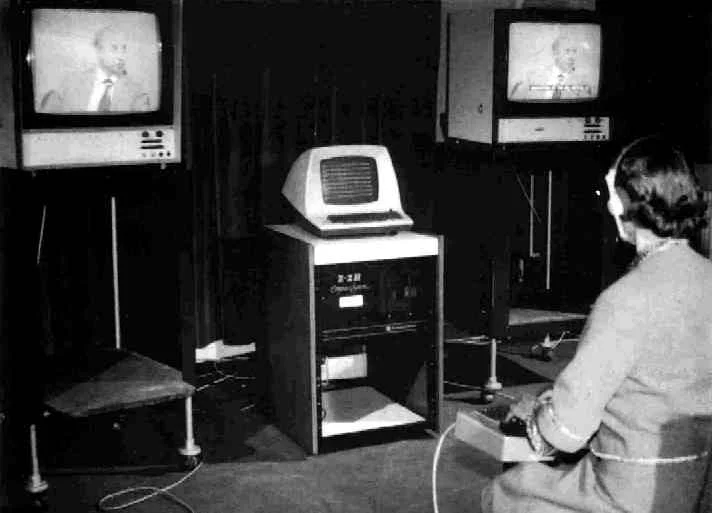
Spotting and Timing
Even with modern technology, it can take up to five hours to spot, or time the in and out cues, for the subtitles of a one-hour talk show.
Spotting, or cueing, is the process of determining the in cue and out cue for each subtitle. The in cue is the exact timestamp when the subtitle appears on screen, and the out cue is the exact timestamp when it disappears.
The Translation Work
Translating a programme from one language to another takes a translator or subtitler between two and four working days of eight hours each. A reference-intensive documentary takes much longer due to the constant need to look up terms.
It takes an experienced subtitler about five days to translate a 90-minute feature film into subtitles.
Reading Speed and Character Limits
One consequence of the shift to printed subtitle cards was a new awareness of reading speed.
A full subtitle of up to two lines is typically shown on screen for about five to seven seconds. During this time, much more can be said in speech than what fits into a subtitle. On average, a subtitler has around 43 characters per line, including punctuation and spaces. This limit can vary depending on character width.
It is essential for the subtitler to condense spoken text without losing meaning, often restructuring sentences to fit. This can confuse viewers who partially understand the source language, but it is a necessary compromise.
A viewer without knowledge of the source language will generally follow the subtitle within the time it is displayed. A skilled subtitler condenses text without losing meaning, detail, or nuance, while adapting the translation to the viewer's cultural context. It is far from the literal translation many assume it to be.
The question every subtitler must ask is: how would someone of the same age and from the same social class say this in the target language, given the same circumstances as the original?
When Subtitles Seem to Contradict the Speaker
The combination of grammar and reading speed can, in extreme cases, result in a subtitle that appears to contradict the spoken word. The subtitle reads "Yes," while the speaker says "No."
Subtitles appear on screen precisely when the speaker starts a sentence and disappear as the words are spoken. Display time varies depending on subtitle length, always between 1.5 and 7 seconds.
Because most subtitlers master this technique reliably, many viewers mistakenly believe they understand the source language well enough not to need the subtitles at all.
Subtitling in the 1980s
In the 1980s, subtitles were first produced using pencil, eraser, and paper. These were then typed on an expensive character generator, which cost around €35,000, by a typist. After that, the translator would spot the in and out cues on the same device.
The Prep Unit
From the mid-1980s onwards, most subtitlers worked on a so-called prep unit. This relatively expensive equipment was loaned or rented to subtitlers so they could work from home, reducing the strain on the expensive character generator at the subtitling company. Many subtitlers also purchased their own prep unit.
A complete setup consisted of a small character generator, a computer with its monitor, a video monitor or television, a modified VCR, and various peripherals.
Timecode
For each translation job, a subtitler received a VHS tape from the client with a transparent or black timeline visible on screen. This running clock, called the timecode, was not only visible on screen but also transmitted to the computer as an audio signal or via hidden image lines.
This made entering in and out cues faster: 16 or 18 digits per subtitle, but the entire timecode could be entered into the field with a single keystroke.
00:01:12:24  (frames)
01:23:07;120  (milliseconds)
Subtitlers could check their work by playing the VHS tape with the running timecode and confirming that subtitles appeared at the correct moment. This process was known as rehearse mode.
After completing the translation, the subtitler submitted a floppy disk containing the translation and in and out cues. This file could then be processed for subtitled video copies, TV broadcasts, or other media. A DVD disc could contain up to 42 subtitle or language tracks.
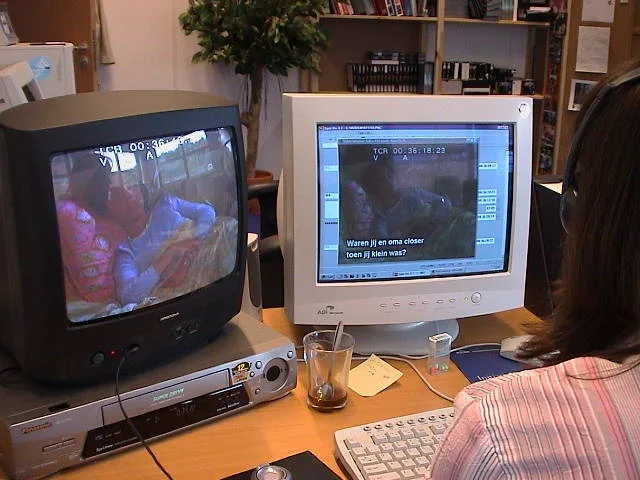
The Shift to Modern Workflows
Today, the prep unit has been replaced by a PC and purpose-built subtitle editing software. Modern subtitlers no longer receive a VHS tape. They download the video file from a client's server, work in software on their own machine, and submit the finished subtitle file the same way.
AI-assisted tools now handle much of the initial transcription and timing work. Yet the subtitler's craft remains relevant. Software can accelerate the process, but producing subtitles that are genuinely readable at the right pace still depends on understanding the standards developed over decades of professional practice.
As AI-assisted subtitling became more common, transcription became fast and cheap, but the craft layer did not automatically come with it. Reading speed, line breaks, timing, and other professional standards still determine whether subtitles are comfortable to watch. That is why we built a free browser-based SRT Editor that checks subtitle files against those standards, so everyone can review their subtitles before publishing.
Read more about it here...
FAQ
For film, text was burned into the celluloid with a chemical process. For television, the camera method was used: a camera was pointed at physical subtitle cards and merged with the broadcast image, with a title director placing each card in the right order at the right moment.
Spotting, also called cueing, is determining the in cue and out cue for each subtitle: the exact timestamps when it appears and disappears. Even with modern tools, spotting a one-hour talk show can take up to five hours.
An experienced subtitler takes about five days to translate a 90-minute feature film into subtitles. Translating a typical programme takes two to four working days, and reference-heavy documentaries take longer.
A subtitler typically had around 43 characters per line, including spaces and punctuation, with a full two-line subtitle shown for roughly five to seven seconds. This is why condensing spoken text without losing meaning has always been central to the craft.
From the mid-1980s, subtitlers worked from home on a prep unit: a small character generator, a computer and monitor, a video monitor, a modified VCR, and peripherals. They received a VHS tape with a visible timecode and submitted the finished subtitles on a floppy disk.